
Utah County
St. George
ELectrician IN LEHI, UTAH
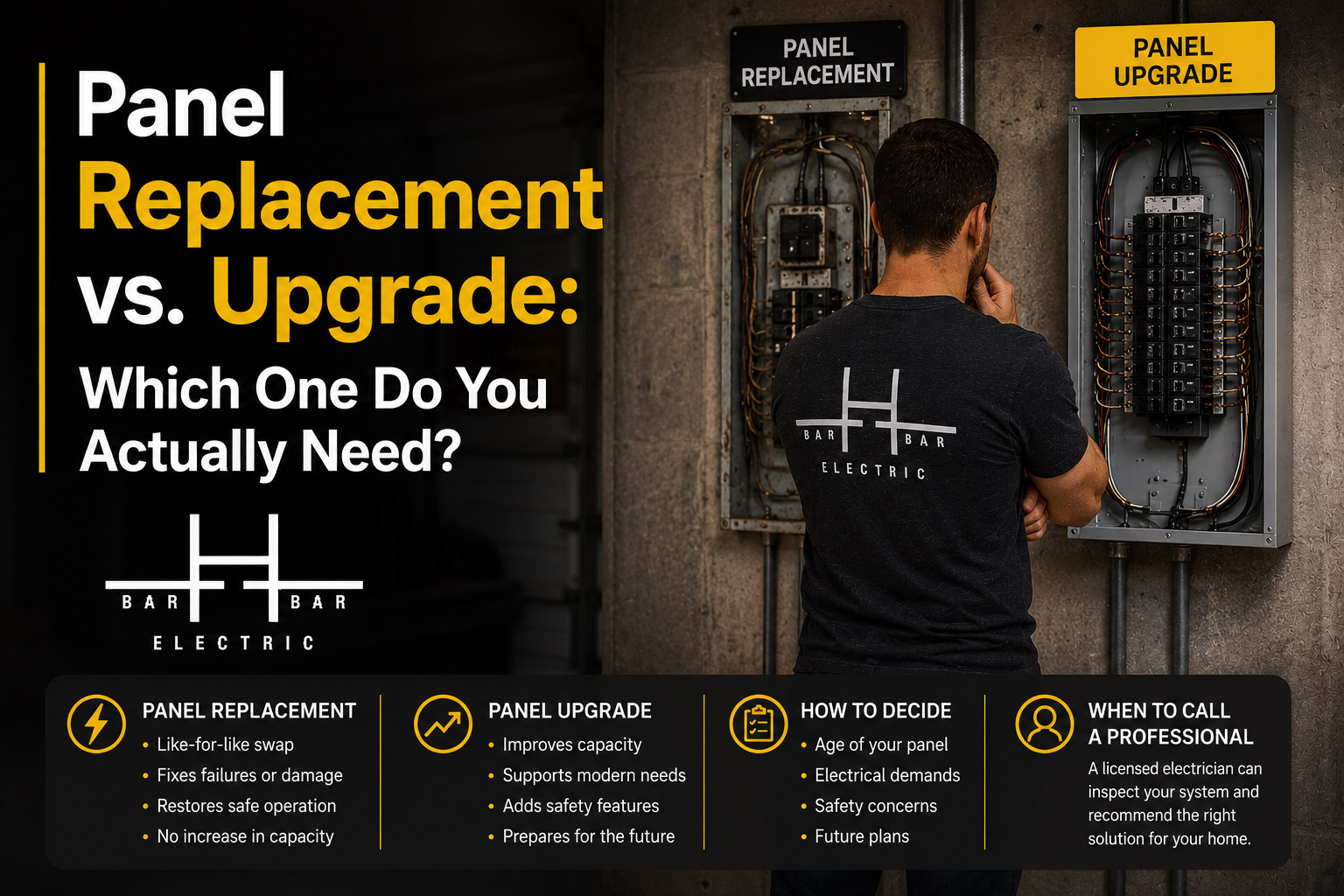
Panel Replacement vs. Upgrade: Which One Do You Actually Need?
When someone tells you your electrical panel needs work, it's common to leave that conversation more confused than when you started. Replacement? Upgrade? Are those the same thing? They're related but distinct, and understanding the difference helps you have a more productive conversation with your electrician — and avoid paying for more work than your situation requires.
This guide explains what each term means, how to tell which one applies to your home, and what the decision-making process actually looks like for homeowners in Lehi, Utah and throughout Utah County.
Defining the Terms
Panel Replacement
A panel replacement means removing the existing breaker box and installing a new one of the same amperage. The capacity of the electrical service — the total amperage coming into the home — stays the same. The reason for replacement is usually the condition or brand of the existing panel, not its size. Certain panel brands have documented safety problems and need to come out regardless of their capacity.
Panel Upgrade
A panel upgrade means increasing the amperage of your electrical service, typically from 100 amps to 200 amps, or from 200 to 400. The old panel comes out and a new, larger panel goes in — but the defining feature is more capacity, not just a newer box. An upgrade also typically involves replacing the service entrance cable and coordinating with the utility company to update the meter base and connections.
Why the Distinction Matters
The two projects have different price points, different scopes of utility involvement, and different reasons for doing them. Conflating them makes it harder to understand what you're actually being quoted for and why.
When You Need a Replacement, Not an Upgrade
Replacement without an upgrade is appropriate when your current amperage is sufficient for your household's needs but the panel itself is the problem. The most common scenarios involve known problem brands.
Federal Pacific Electric (Stab-Lok) Panels
FPE panels, manufactured under the Stab-Lok brand, were widely installed in American homes from the 1950s through the 1980s. Testing and investigation have revealed that their breakers fail to trip under overload conditions at an alarming rate, meaning the protection they're supposed to provide often doesn't materialize. Homes in Lehi, Utah with original construction from that era may still have these panels. Replacement is strongly recommended regardless of amperage.
Zinsco Panels
Zinsco panels have a similar history of documented failure. Their bus bars — the internal components that breakers clip onto — corrode and lose connection, causing breakers to appear functional while providing no actual overload protection. Like FPE panels, Zinsco replacement is a matter of safety, not capacity.
Panels with Physical Damage or Corrosion
A panel that shows burn marks, rust, moisture intrusion, or physical damage to the enclosure or bus bars needs replacement even if none of the above brand issues apply. The integrity of the enclosure and the condition of internal components determine whether replacement is necessary on condition grounds alone.
When You Need an Upgrade, Not Just a Replacement
An upgrade is called for when the current amperage is genuinely insufficient for the home's electrical demand. The following circumstances are the most common indicators that capacity — not just panel condition — is the issue.
The home was built with 100-amp service and now runs multiple high-draw appliances including electric range, electric dryer, central air conditioning, and a hot tub or pool
You want to add an EV charger and your panel cannot support the additional 50-amp circuit without consistently tripping
You're adding a significant addition to the home — a primary suite, in-law apartment, or large workshop
You're converting from gas appliances to electric and need to add high-amperage circuits for a range, dryer, or heat pump system
A licensed electrician has evaluated the panel's load capacity and determined it's operating near or at its maximum
Can You Have Both?
Yes, and this is common. A home with a 100-amp Federal Pacific panel needs replacement for safety reasons and an upgrade for capacity reasons. In that case, the work is scoped as a single project: the FPE panel comes out, the service entrance is upgraded, and a new 200-amp panel goes in. The homeowner gets both safety and capacity in one job.
The distinction between replacement and upgrade still matters even when both are needed, because it affects the utility coordination required, the materials specified, and ultimately the final cost.
How to Know Which One Applies to Your Home
The process for determining whether you need replacement, upgrade, or both follows a logical sequence that a licensed electrician walks through during an inspection.
Identify the existing panel brand and model to check for known safety concerns
Evaluate the physical condition of the enclosure, bus bars, and breakers
Calculate the approximate current load against the panel's rated capacity
Review the homeowner's planned additions or changes that will add to the load
Assess the service entrance cable condition and meter base for compatibility
Make a recommendation based on safety and capacity findings
This process takes a licensed electrician typically 30 to 60 minutes on-site. An honest assessment will tell you exactly what's needed and why, without recommending more work than the situation requires.
FAQs: Panel Replacement vs. Upgrade
How do I find out what brand of panel I have?
Open the panel cover — the door over the breaker handles — and look for a brand name or logo on the breaker faces or the interior of the enclosure. You can also look for a label on the inside of the door that lists the panel specifications. If you're not comfortable opening the panel yourself, an electrician can identify it during a service call.
Is it possible to just add a sub-panel instead of upgrading the main?
A sub-panel distributes circuits from the main panel to a remote location — a garage, workshop, or addition — but it doesn't add capacity to the home's total service. If the main panel is at capacity, adding a sub-panel without upgrading the main simply moves the capacity problem rather than solving it. Sub-panels are genuinely useful for convenience and organization when the main panel has sufficient capacity.
Will my insurer require me to replace a problem-brand panel?
Some insurers in Utah have begun requiring replacement of Federal Pacific Electric and Zinsco panels as a condition of coverage or renewal. If you're purchasing a home with one of these panels, your insurer may raise a flag during underwriting. It's worth asking your insurance agent directly about their policy on specific panel brands.
How often should a panel be inspected if no known problems exist?
A general electrical inspection, which includes the panel, every ten years is a reasonable baseline for homes with no known issues. Homes that have undergone additions, major appliance changes, or are approaching 30 or more years old without a panel review benefit from more frequent inspection. Lehi, Utah's rapid residential development means many homes are relatively new, but older neighborhoods contain homes well past that threshold.
Can an upgrade be done in two stages to spread out cost?
Staged upgrades are not really feasible because the utility disconnect and permit inspection make it a single-event project. However, if cost is a significant concern, financing options are often available through electrical contractors, and some work — like a sub-panel addition — can be done as a separate, smaller project to add circuit capacity in a specific area while a full upgrade is planned for the future.
Conclusion
Replacement and upgrade are related but distinct decisions, and knowing which one applies to your situation makes you a better-informed consumer when getting quotes and evaluating recommendations. A safety-driven replacement and a capacity-driven upgrade have different triggers, different scopes, and different costs. Bar H Bar Electric provides honest, straightforward panel assessments for homeowners throughout Lehi, Utah and the surrounding communities. If you're not sure what your panel actually needs, a free estimate is the right first step.

Our Services
Helpful Links
Contact Information
Phone
Utah County: (385) 257-3541
St. George: (480) 686-5978
Business Hours
Mon - Fri: 8:00 am - 5:00 pm
Sat - Sun: Closed
© 2026 All Rights Reserved | Bar H Bar Electric
Website Done By: LocalEyes